November is the month your yard tells the truth. The leaves are down, the rain is cold and steady, and the low spots that hid under summer grass start holding water for days. If you have puddles that never seem to dry, a soggy strip along the house, or mulch washing onto the walkway, now is the time to look at real yard drainage solutions.
The window is short. Once the ground freezes, digging stops, water has nowhere to soak in, and every thaw sends runoff across frozen soil toward the lowest point it can find. Too often, that low point is your foundation. Our team at Colonel Landscaping installs yard drainage systems across southeastern Connecticut, and this guide covers what we check before winter, what you can do yourself, and what to watch from November through January.
Quick Answer: Which Yard Drainage Solution Fits Your Problem?
| What you see | Likely cause | Best-fit solution | Can it be done before winter? |
|---|---|---|---|
| Water pooling against the foundation | Soil sloping toward the house, short downspouts | Regrading so the ground falls away from the house, downspout extensions | Yes, while the ground is workable |
| A low spot in the lawn that stays wet for days | Water collecting with no way out, compacted soil | French drain or catch basin piped to a safe outlet | Yes, until the ground freezes |
| Puddles on or beside a patio, walkway or driveway | Hard surface sheds water onto one spot | Channel (trench) drain | Usually, if the surface can be cut |
| Water running across the yard from uphill | Runoff from a slope or a neighbor’s property | Swale (shallow grass-lined channel) or French drain to intercept it | Grading yes, seeding waits for spring |
| Soil and mulch washing out of beds | Concentrated runoff, bare soil | Redirect the water first, then stabilize the soil | Redirect now, seed or plant in spring |
| Roof water dumping at the corner of the house | Downspout ends at the foundation | Downspout extension or buried pipe to a dry well | Yes, often in a day |
Why Fix Yard Drainage Before the Ground Freezes?
Water that sits in the soil around your house in late fall is the water that freezes there in January. The Connecticut State Building Code lists a frost line depth of 42 inches for our state, which tells you how deep cold can reach in a hard winter. Frozen ground cannot absorb rain or snowmelt, so water runs across the surface and collects in the same low spots every time it thaws.
Three things make late fall the practical deadline:
- Digging gets harder by the week. French drains, catch basins and buried downspout lines all need trenches. Frozen soil turns a one-day job into a wait until spring.
- Your problem areas are easiest to see now. With the leaves down and the grass slowing, you can watch exactly where water goes during a November rain.
- Spring melt is the big test. Snow that piles up all winter melts all at once. A drainage fix in place by December is ready for March.
What Are the Signs of a Yard Drainage Problem?
Walk your property during or right after a steady rain. These are the same warning signs we list on our yard drainage service page:
- Puddles that are still there a day or more after the rain stops
- Muddy, spongy lawn areas that squish underfoot
- Water pooling along the foundation or a damp basement after storms
- Mulch, soil or gravel washed onto walkways and driveways
- Moss, mildew or algae in the same shady, wet spots
- Mosquitoes hanging around standing water in warmer months
Quick test: take a photo of each wet spot during the rain and again 24 hours later. Those photos are the most useful thing you can show a drainage contractor.
How Should the Ground Slope Around Your House?
Grading is the first thing we check, because no drain can keep up with soil that tips water toward your home. The International Residential Code, which Connecticut’s building code is based on, says lots must be graded so surface water drains away from foundation walls, with the ground falling at least 6 inches within the first 10 feet (section R401.3). Where a wall, lot line or slope makes that impossible, the code calls for drains or swales to move water away instead.
You can check this yourself with a string line, two stakes and a level. Run the string level from the foundation out 10 feet and measure down to the soil at the far end. If the drop is small, or the ground actually rises away from the house, regrading belongs at the top of your list.
Common grading fixes
- Rebuilding the slope with clean fill along the foundation so water moves outward
- Shallow swales that carry water around the house instead of toward it
- Keeping beds and mulch below the siding so soil does not hold water against the wall
Where Should Downspouts Drain?
A single roof can shed a surprising amount of water onto one corner of a house. The UConn NEMO program advises that if you have a basement, roof water should be discharged at least 10 feet from the foundation so it does not find its way into the foundation. The U.S. EPA also recommends redirecting downspouts to a lawn, garden or rain barrel where water can soak in instead of running off.
Before winter:
- Clear gutters and downspouts of leaves so meltwater has a path off the roof.
- Add extensions so water lands well away from the house and on ground that slopes away.
- Point the outlet where water can spread out, not toward a neighbor, driveway or walkway that will ice over.
- For a permanent fix, have the downspout piped underground to a dry well or daylight outlet.
Which Yard Drainage Solutions Work Best in Connecticut?
Every property is different, but most of the systems we install fall into five groups.
French drains
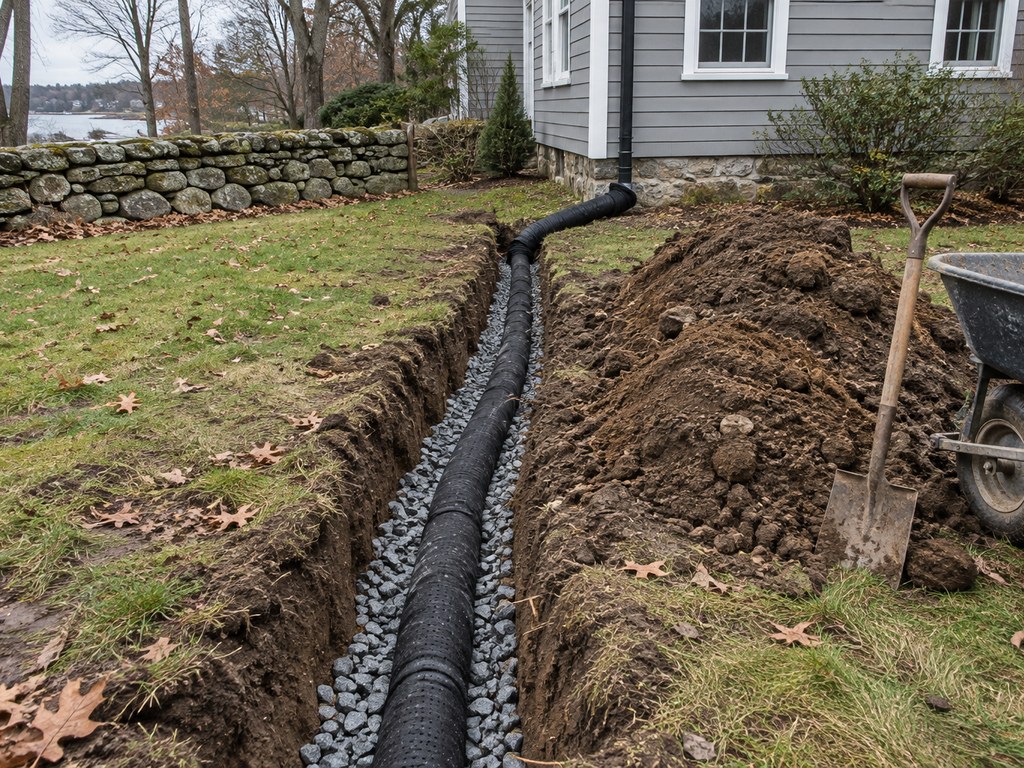
A French drain is a trench lined with fabric, filled with gravel and fitted with a perforated pipe. It catches water in the soil and carries it to a safe outlet. It is the go-to fix for a wet strip along a house or a soggy section of lawn, and it is completely hidden once the lawn grows back.
Catch basins and dry wells
A catch basin is a grated box set at the lowest point of a wet area. It collects surface water and sends it through a pipe. A dry well is an underground chamber that holds that water and lets it soak slowly into the soil. Together, they handle heavy downpours and downspout water on yards with nowhere to drain.
Channel and trench drains
These long, narrow grated drains are set into patios, walkways and driveways. They catch water that sheets off hard surfaces before it pools or turns into an ice patch at the bottom of the driveway.
Swales and regrading
A swale is a wide, shallow, grass-lined channel that guides water across a yard. Paired with regrading, it is often the most natural-looking way to move water away from the house and around outdoor living areas.
Rain gardens
A rain garden is a planted, shallow basin that collects runoff and lets it soak in. UConn’s rain garden guidance says to keep one at least 10 feet from a house with a basement, at least 25 feet from wells and septic systems, and out of low spots that are always wet, since poorly drained soil can leave water standing. Rain gardens are best planned in winter and planted in spring.
What Can You Do in November, December and January?
Not every fix needs an excavator. Use this seasonal checklist to protect your yard until a permanent solution is in place.
November: before the freeze
- Clean gutters after the last leaves fall and check every downspout for clogs.
- Add or lengthen downspout extensions.
- Clear leaves out of any existing catch basins, grates and channel drains.
- Rake leaf piles out of swales and low spots so water can move.
- Book any trenching work now, while the ground can still be dug.
December: watch and protect
- Shovel and plow snow away from the foundation, not onto it.
- Keep snow piles off drain grates and outlets so meltwater has somewhere to go.
- Use sand instead of salt near lawns and beds when you can. UConn’s Home and Garden Education Center notes that salt can end up on the lawn and damage plant roots.
- Stay off frozen grass. UConn points out that without snow cover, frozen grass blades break easily and can die back.
January: thaw days are test days
- On a mild day after a snowfall, walk the yard and note where meltwater collects.
- Check the basement and the base of exterior walls for dampness after each thaw.
- Watch for ice forming in the same spot on walkways and driveways. Repeated ice is usually a drainage problem, not just a weather problem.
- Add your notes and photos to your spring project list.
Can Drainage Work Be Done in Winter?
Some of it can. Downspout extensions, gutter fixes and clearing drains can happen any time. Trenching for French drains, catch basins and dry wells depends on the ground. Once the soil is frozen hard, most excavation waits for a thaw or for spring.
Any project that involves digging also needs a utility mark-out. Connecticut’s Call Before You Dig rules require notice to the one-call center at least two full business days, and no more than 30 days, before excavating. You can request a mark-out through Call Before You Dig or by calling 811. A professional contractor handles this step for you.
When Should You Call a Yard Drainage Contractor?
DIY fixes are a great start, but call a professional when:
- Water reaches the foundation or the basement after storms
- The same low spot floods every time it rains, even after you have redirected downspouts
- Runoff is coming from a slope, the street or a neighboring property
- Erosion is cutting into beds, slopes or the edge of a driveway
- You need water carried under a lawn, walkway or patio to an outlet
Questions to ask before you hire
- Where exactly will the water go once it is collected?
- Will you check the grade around the house, not just install a drain?
- Which system fits my soil, slope and the amount of water I see?
- How will the lawn and beds be restored after trenching?
- Will you request the Call Before You Dig mark-out?
- What maintenance will the system need each year?
How Colonel Landscaping Plans a Drainage Project
We start with a walk of your property, ideally right after rain. We look at the grade around the house, where downspouts discharge, where water enters the yard and where it can safely leave. From there, we recommend the simplest system that solves the problem: sometimes regrading and downspout extensions are enough, and sometimes a French drain, catch basin or dry well is the right call.
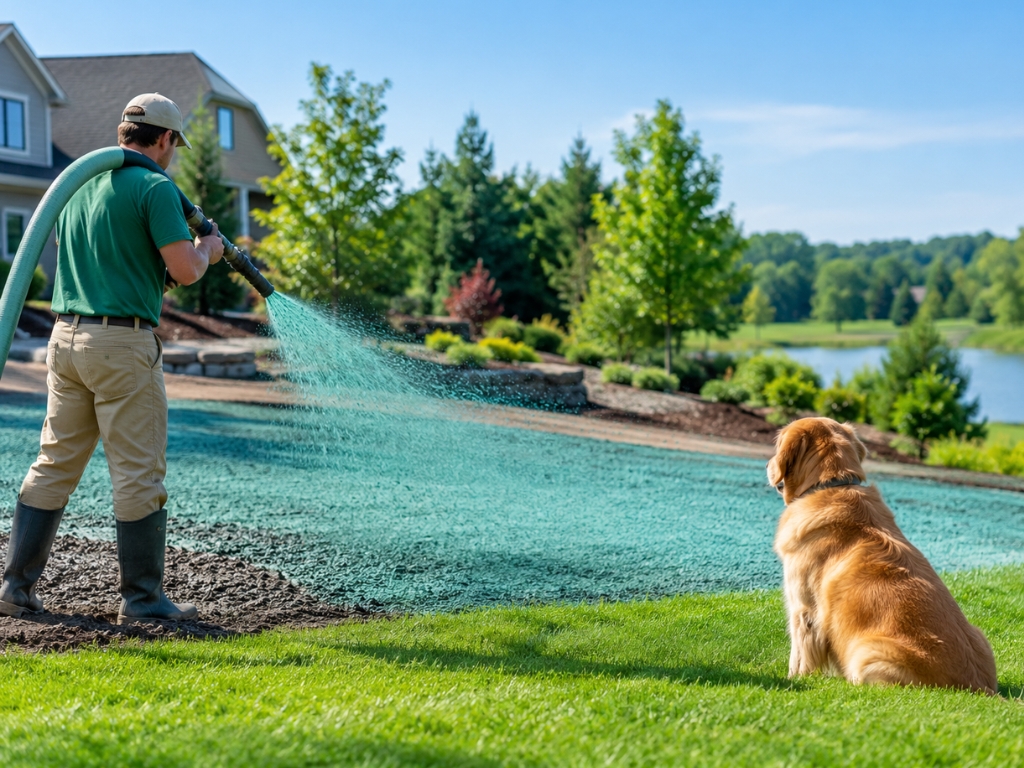
Because we also handle lawn care and repair, we think about what the yard looks like after the work, not just under it. Where trenching or regrading leaves bare soil on a slope, hydroseeding for erosion control is one way we get grass established again once the growing season returns. If you are still getting the yard ready for winter, our fall cleanup checklist covers the rest.
Frequently Asked Questions
What is the cheapest yard drainage solution?
Fixing downspouts is usually the least expensive place to start. Clean gutters and extensions that carry roof water well away from the house solve a surprising number of wet-foundation problems. Simple regrading near the house is often next.
Is a French drain or a swale better for my yard?
A swale moves surface water and works well on gentle slopes with room for a wide, shallow channel. A French drain handles water in the soil and fits narrow spaces, such as along a house or between a patio and a lawn. Many yards use both.
Can I install a French drain in December?
Only if the ground is not frozen. Conditions change quickly from one week to the next in December, so plan early. If the ground freezes, plan the project now and schedule installation for the first workable days of spring.
Why does my yard flood in winter when it did not in summer?
Frozen or saturated soil cannot absorb water, and grass and plants are dormant, so they take up very little. Rain and snowmelt run across the surface and collect in low spots that dry out quickly in summer.
Do I need a permit for yard drainage in Connecticut?
It depends on your town and the project. A simple downspout extension is usually a minor job, while work near wetlands or watercourses, or connections to a street drain, may need town review. Check with your town’s building or land use office, and always request a Call Before You Dig mark-out before any digging.
How do I know where to send the water?
Water should go to a spot that is lower than the problem area, away from your foundation and any well or septic system, and not onto a neighbor’s property, the street or a walkway that will freeze. A contractor can confirm the best outlet during a site visit.
Get Your Yard Ready Before the Ground Freezes
Every wet spot you fix this fall is one less ice patch, soggy lawn or damp basement this winter. If water is collecting where it should not, our team can walk your property, show you where the water is going, and recommend yard drainage solutions that fit your home.
Call Colonel Landscaping at 860-300-3497 or request a free yard drainage estimate today.